Africa medical exhibition
Africa medical exhibition: devices, innovation and partnerships in Morocco
Criteria for showcasing, sourcing and distributing medical devices and healthcare solutions between Morocco and Africa.
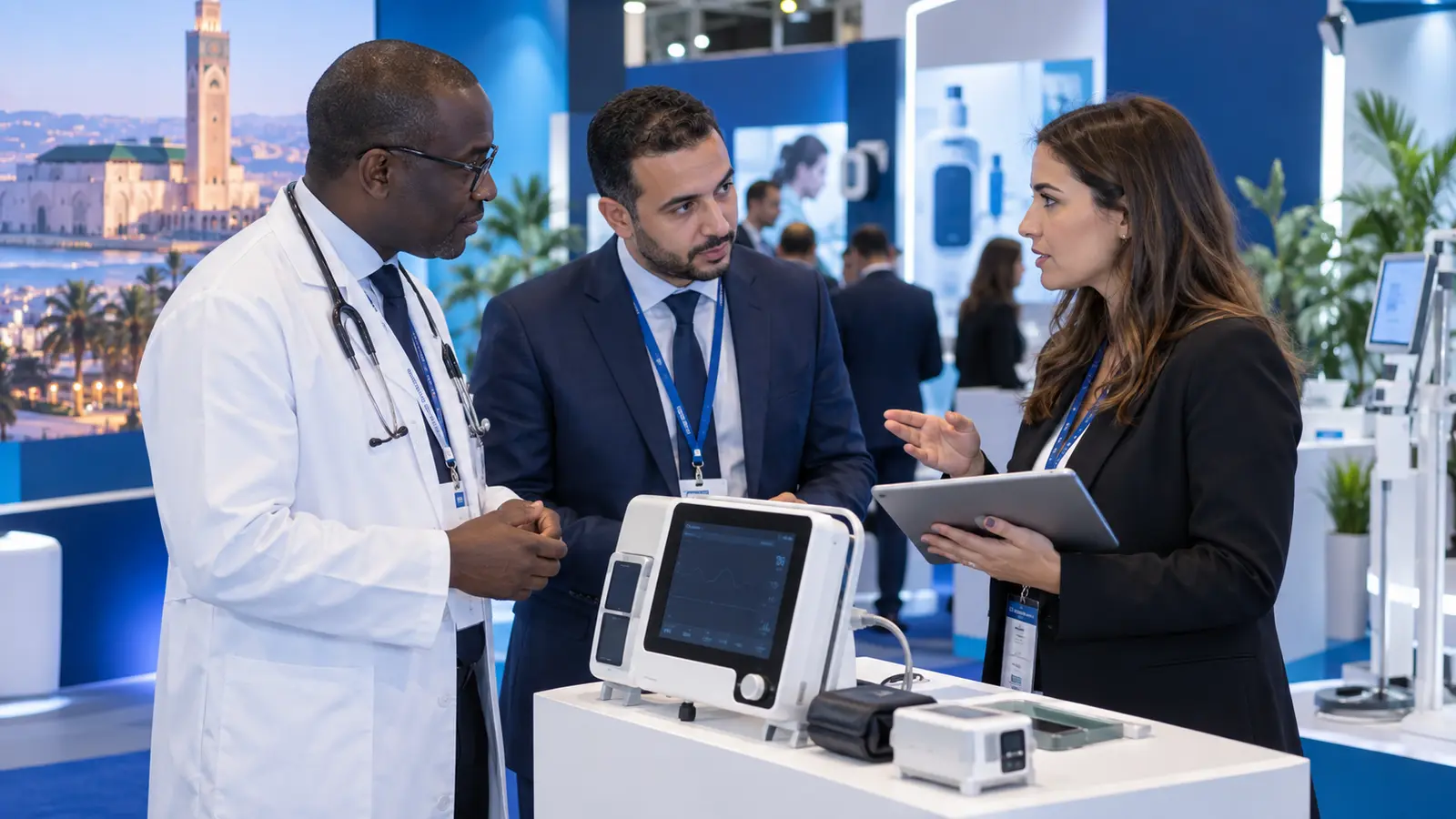
An Africa-focused medical exhibition must go beyond equipment display. Buyers and partners need to understand use, total cost, maintenance, availability, training and the support required for a solution to operate sustainably.
The Pharma Health Expo medical journey creates a comparison space for manufacturers, distributors, practitioners, facilities, buyers and technology providers from Morocco and Africa.
A market focused on applicable solutions
Decision-makers need equipment, consumables, software and services that answer practical needs. Performance depends on more than technology: reliability, usability, maintenance, consumable availability, training and total cost of ownership all influence decisions. Exhibitors should demonstrate the solution in the context where it will actually be used.
Identify the right decision-makers
Depending on the offer, relevant contacts may include distributors, importers, facilities, practitioners, technical leaders, buyers, integrators and institutions. Effective prospecting distinguishes user, prescriber, payer and final decision-maker. This map helps adapt the demonstration and prevents conversations with no clear decision path.
Prepare technical and commercial information
Buyers expect clear documentation covering intended use, performance, applicable conditions, installation, maintenance, consumables and after-sales support. Pricing should show initial and recurring costs. Requirements for every market must be confirmed with competent authorities and qualified professionals before commitments are made.
Select a capable distribution partner
Commercial reach alone is insufficient for technical solutions. Review installation capacity, technicians, spare-parts inventory, response times, training and traceability. Existing references and documented support procedures are more informative than general promises. Responsibilities should be reflected in the agreement.
Use Casablanca to compare models
Morocco provides a relevant setting for connecting manufacturers, distributors and decision-makers from several markets. Demonstrations help compare usability, integration, support and total cost. B2B meetings make it easier to qualify partners and design a market-access plan suited to each territory.
Build a gradual deployment
A pilot can measure adoption, incidents, training needs, availability and user satisfaction. Findings improve documentation, support organisation and the business model. This gradual approach gives partners greater confidence and prepares controlled expansion into additional accounts or African markets.
Key actions
Present a credible medical solution
Commercial demonstrations should be supported by a verifiable deployment and service model.
- Document use, performance, installation, maintenance and consumables.
- Identify user, prescriber, payer and decision-maker for every project.
- Assess the local partner’s technical and commercial capabilities.
- Begin with a pilot and indicators covering adoption and service quality.
FAQ
Frequently asked questions
Which areas does the medical journey cover?
It includes medical devices, diagnostics, orthopaedics, digital health, software, services, prevention and technologies for healthcare professionals.
Why is after-sales support essential?
Continuity depends on installation, maintenance, parts, consumables, response times and user training.
How should meetings with medical distributors be prepared?
Prepare documentation, target territories, the business model, technical responsibilities and clear partner-evaluation criteria.